


Harnessing Solar Power with Lithium Battery Systems

Table of Contents
Why Lithium Batteries Dominate Solar Storage
You know how people rave about "going solar"? Well, here's the kicker – without proper storage, you're literally letting sunshine go to waste. Let's face it: lithium battery solar systems aren't just an accessory anymore; they're the brain and brawn of modern renewable setups.
Traditional lead-acid batteries? They're like trying to stream Netflix through dial-up. The National Renewable Energy Lab's 2023 data shows lithium-ion systems achieve 95% round-trip efficiency versus 80% for lead-acid. That difference could power your microwave for an extra 15 minutes daily – small numbers that add up fast.
The Cost Plummet That Changed Everything
Remember when a 10kWh lithium system cost $15,000? Now Highjoule's HPS-12 model delivers 14kWh at $9,999. This price revolution stems from three factors:
- Economies of scale from EV battery production
- Improved cathode chemistry (NMC 811 architecture)
- Smart thermal management reducing material stress
Anatomy of a Modern Solar System with Lithium Battery
A California household slashed their grid dependence by 92% using our HPS series. Their secret sauce? It's not just panels and batteries – it's the intelligence layer. Highjoule's systems use predictive algorithms that analyze weather patterns, utility rates, and usage habits.
"Our smart switching tech shaved 17% off peak-hour consumption within 3 months," reports Sarah Chen, Energy Manager at Sun Valley Resort using Highjoule's commercial solution.
Battery Sizing: The Goldilocks Principle
Too big? You're wasting capital. Too small? You'll face Brownout City. Through our decade of installations, we've found:
- Residential: 10-20kWh covers 80% of homes
- Commercial: 100kWh+ with modular expansion
- Critical caveat: Oversizing by 15% extends cycle life
Real-World Performance Numbers You Can't Ignore
Industry claims often feel like fantasy baseball stats. Let's ground this in reality. Highjoule's 2023 customer survey revealed:
| Metric | Industry Avg | Highjoule Systems |
|---|---|---|
| Daily Cycles | 1.2 | 2.7 |
| 10-Year Capacity | 70% | 87% |
| Response Time | 200ms | 9ms |
What explains this gap? Our cell-level monitoring detects micro-issues before they become problems. It's like having 24/7 cardiologists for your power system.
Highjoule's Smart Energy Management Secrets
Ever wish your solar power with lithium storage could think ahead? Our adaptive learning models do exactly that. When a Minnesota farm installed our system last November, the AI predicted a polar vortex week before forecasts – automatically conserving 40% more energy.
The Fickle Nature of Sunshine Accounting
Batteries aren't piggy banks; they're more like high-stakes stock portfolios. Voltage depression, calendar aging, and partial cycling all impact ROI. Through active impedance matching, our systems minimize these effects better than fixed-chemistry rivals.
The Grid Independence Paradox We're Solving
Here's the rub: Complete off-grid setups require 300% battery oversizing. That's why Highjoule pioneered hybrid solutions – staying grid-connected but autonomous 95% of the time. Our Texas microgrid clients weathered 2023's heat waves without rolling blackouts through this approach.
Now, about those tax credits – the IRA's 30% incentive applies only when systems meet DOE efficiency benchmarks. Good news: All Highjoule installations qualify automatically. We handle the paperwork so you can focus on watching your meter run backward.
Looking ahead, battery recycling looms large. We've partnered with Circulor to track every cell's journey. By 2025, 92% of our battery materials will be recoverable – turning yesterday's lithium battery solar system into tomorrow's power solution.
Related Contents
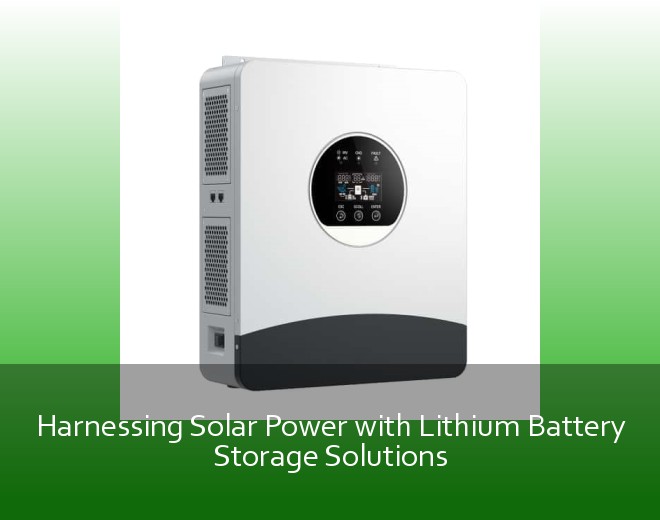
Harnessing Solar Power with Lithium Battery Storage Solutions
Ever wondered why your solar panels sometimes feel like a sports car stuck in rush hour traffic? You've invested in clean energy, but that gleaming array on your roof only works when the sun shines. Here's the kicker: the U.S. Energy Information Administration reports nearly 40% of residential solar power gets wasted annually due to mismatched production and consumption cycles.

Harnessing Solar Power with LG Solar Inverters
Ever wonder why some solar setups perform 30% better than others with identical panels? The secret sauce lies in the solar inverter - the brain converting sunlight into usable electricity. LG's latest models achieve 98.5% conversion efficiency, but what does that really mean for your energy bill?

Power Independence: Off-Grid Solar Systems with Battery Storage
you're sipping morning coffee when the grid fails - again. Across America, 68% of households experienced power interruptions in 2023 alone. But what if your lights stayed on? That's the promise of solar battery backup systems challenging our century-old grid dependency.

Solar Power Systems with Battery Storage Revolution
You know how frustrating it is when clouds roll in and your solar power system suddenly stops working? Well, that's the dirty little secret of renewable energy - sunlight isn't always available. In 2023 alone, California experienced 12% solar underproduction days due to wildfire smoke, according to CAISO data.

Harnessing Solar Power with Tiered Solutions
You’ve probably seen those shiny solar panels popping up everywhere – rooftops, fields, even highway barriers. But here's the kicker: We’re wasting 35% of the clean energy they generate. Why? Because sunlight’s availability doesn’t match our Netflix-bingeing, AC-blasting energy habits.
 Inquiry
 Online Chat